

Billing for SMS messages
If Customer.io bills you for SMS messages directly, your plan includes a monthly number of SMS segments, where a segment is a single SMS message of up to 160 characters. If you exceed that limit, you'll pay an additional fee for each SMS message segment that you send.
How it works
SMS billing is mostly concerned with message “segments,” where each segment is up to 160 characters—what you might sometimes see as a single chat bubble in traditional SMS applications. Your plan includes a base number of SMS segments per month. If you use more than your allotted segments, you’ll pay an additional fee for each segment you send.
For example, if you send an SMS from Customer.io containing 200 characters, that consumes two “segments”; it may even appear to your audience as two separate chat bubbles. We help you calculate the number of segments you’ll consume to send an SMS message.
There are also other one-time fees that you can encounter as you register new phone numbers, brands, and campaigns.
Where can I see my available SMS segments and usage?
If you’re billed through Customer.io, you can see your SMS credits on the Plans & Billing page.
If your SMS provider bills you, you’ll see your allotment of segments and usage in their console (like the Twilio Console).
What constitutes an SMS segment?
Generally, SMS segments are limited to 160 characters. However, if you use special characters like emojis in your message, you’ll be limited to 70 characters. Learn more about SMS message encoding.
MMS messages—messages that contain images or other media—consume three segments per message.
Inbound messages consume segments too. A reply to one of your messages consumes one segment (or three if it includes media). This includes STOP and other keyword replies.
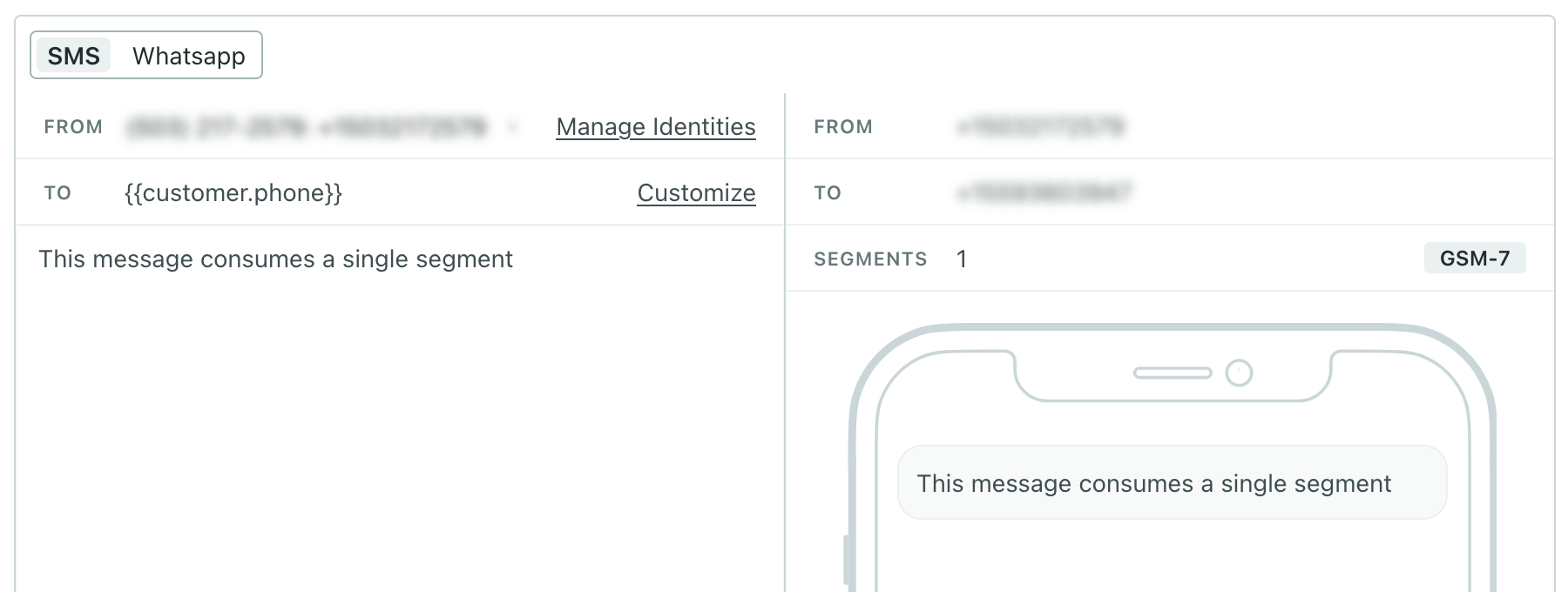
When you write a message in Customer.io, we’ll help you calculate the number of segments you’ll use per message.
Overage fees
If you exceed the SMS limits for your plan, you’ll incur additional fees, which are automatically charged to the payment card on your account in your regular monthly billing cycle.
In general, if you only send messages for your own account—you run a single business entity and you send messages directly to your users or customers—you’ll only see SMS overages.
If you’re a business with different sub-entities or you’re an agency that manages accounts for multiple clients who send messages to their customers or users, you may see additional fees like Sender or One-Time coverage fees.
SMS message overages
Each SMS segment over your plan limit costs $0.0120. Where a segment is up to 160 characters, typically represented as an individual chat bubble going to a single recipient.
So, if you send a message from Customer.io containing 200 characters, that appears to your audience as two messages—two chat bubbles—and consumes two segments per recipient. If you send that message to 100 recipients, you’ll use 200 segments, and you’ll be charged $2.40.
Sender, campaign, and one-time overage fees
If you manage multiple SMS senders on behalf of your clients, you may encounter overages for sender numbers, campaigns, and A2P 10DLC brand registrations. Learn more about A2P 10DLC brand registrations below.
The word “campaign” here is a regulatory term that refers to the kinds of messages that you send.
One-time fees are charged to the payment card on your account in your regular monthly billing cycle.
- Sender number fees
- Toll-free numbers: $2.50 per additional number per month
- Long code numbers (10DLC): $2.50 per additional number per month
- Short code numbers: $1,000 per additional number per month
- Campaign registration fees: $12.50 per additional campaign per month
- One-time overage fees:
- 10DLC brand registrations: $50 per additional brand
- Campaign use case registrations: $20 per additional campaign
STOP message responses
If Customer.io began managing SMS for your account before September 15, 2026, someone who texts STOP gets an automatic reply confirming the opt-out.
The automatic reply goes through Twilio; it’s not a part of a Customer.io-triggered automation, so you won’t see it in the person’s activity. But your bill still reflects it, because it’s an outbound message from your sender number. To change the reply text, contact support@customer.io.
If you contract your own SMS provider, the automatic reply depends on your provider: Twilio sends one by default, and you pay for it as an outbound message; Sinch, Infobip, and Vonage do not send an automatic reply. See opt-out keyword handling.
Customer.io records the inbound STOP and adds an inbound SMS event to the person’s profile. This opts the person out of SMS from that sender and marks the message they replied to as replied. See inbound messages for more information.
What is A2P 10DLC?
A2P 10DLC stands for Application to Person 10-digit Long Code. It’s a regulatory standard in the United States that governs communications between businesses and recipients, to prevent spam and unsolicited messaging.
When you register for a 10DLC number, you’ll register for at least one brand and one campaign, where the brand is who sends your messages and the campaign is the “kinds” of messages that you send. A brand can have multiple campaigns and an account can have multiple brands!
Registering your brands and campaigns helps cellular carriers understand who sends messages and why. This helps carriers and customers trust the businesses that send messages.
What is a brand?
Think of the brand as “who” sends your messages.
If you’re a business that sends SMS messages directly to your customers, then you’re a single brand. Your customers or users recognize you as a single entity.
But imagine that you’re a business with multiple entities: like a parent company called Acme with different subsidiaries called Acme Anvils, Acme Rocket Skates, and Acme Pianos. Your audience can register for messages from the parent or any of the subsidiaries, meaning you have four brands. This means that it’s likely you’ll have at least four phone numbers, one for each brand.
See Twilio’s documentation for more about brands and brand types.
What is a campaign?
As it relates to A2P 10DLC, a campaign is a regulatory term that refers to the kinds of messages that you send.
Think of a campaign as the kinds of SMS messages you want to send. For example, you might send two-factor authentication codes and promotional content. These might represent two campaigns. Someone may want a two-factor authentication code but they may not want to receive promotional content.
A brand can register up to five different campaigns. See the complete list of campaign use cases.
What are one-time fees?
Whenever you register a new brand or a new campaign, you’ll incur a one-time registration fee as a part of your regular monthly billing cycle.
What is a sender number?
A Sender number is a phone number that you use to send SMS messages. You can use a toll-free number, a long code number, or a short code number. You can have multiple sender numbers, and you can use them to send messages to different audiences.
Each phone number is typically associated with a brand and a campaign.